How to Design a Warehouse Racking System That Works

Designing an efficient storage infrastructure is one of the most consequential decisions in any warehousing project — and yet it’s often treated as an afterthought. In Malaysia’s rapidly expanding logistics and manufacturing sectors, from the Shah Alam industrial corridors to the port-adjacent distribution hubs in Penang and Johor Bahru, poorly planned racking layouts are costing businesses time, money, and operational agility.
A well-executed warehouse racking system design goes far beyond simply stacking shelves. It directly impacts forklift traffic flow, inventory accessibility, structural load requirements, and critically compliance with local building and safety codes.
In this guide, we’ll walk you through the key steps involved in designing a warehouse racking system that is functional, safe, and scalable. Whether you’re planning a new industrial facility or retrofitting an existing one, understanding this process from an architectural standpoint will help you make far better decisions. For a broader overview of how racking fits within the full scope of facility planning, take a look at this comprehensive guide to planning industrial facilities in Malaysia.
Step 1: Define Your Operational Requirements First
Every effective warehouse racking system design starts not on a drawing board, but with a detailed understanding of how the space will actually function. Architects and industrial designers working on warehouse projects in Malaysia must gather operational data before committing to any structural or spatial decisions.
Key questions to answer at this stage include:
- What SKUs (stock-keeping units) will be stored, and what are their dimensions and weights?
- What is the expected inventory turnover rate? High-velocity items need accessible ground-level or end-aisle positions.
- What handling equipment will be used? Reach trucks, forklifts, and automated guided vehicles (AGVs) each require different aisle widths and clearance heights.
- What are the peak storage volume projections over the next 5–10 years?
In Malaysia, many logistics operators in areas like Klang Valley or Iskandar Malaysia are rapidly scaling their e-commerce fulfilment operations. This growth means racking systems need to be designed not just for today’s inventory, but for tomorrow’s throughput. Engaging an experienced industrial design architect at this phase ensures that operational reality is translated into a viable spatial brief from the outset.
Step 2: Conduct a Structural and Site Assessment
Before any racking configuration can be finalised, a thorough assessment of the building structure and site conditions must be carried out. This is a step that is too often skipped particularly in older industrial buildings and it can have serious consequences.
The key elements of this assessment include:
- Floor load capacity: The concrete slab must be rated to handle not just the weight of the racking itself, but the full load of stored goods and operating machinery. In Malaysia, this typically means compliance with the Uniform Building By-Laws (UBBL) and relevant MS standards.
- Clear internal height (CIH): This determines how many vertical levels of racking are feasible. A building with a 10-metre CIH, for instance, may comfortably accommodate four to five racking levels depending on pallet dimensions and forklift mast height.
- Column grid and obstruction mapping: Racking rows must be laid out around structural columns, fire suppression systems, and electrical conduits. An experienced warehouse design team will integrate these constraints directly into the racking layout plan.
- Fire safety compliance: BOMBA requirements in Malaysia mandate specific sprinkler placement relative to racking heights, which affects both rack configuration and ceiling-level systems.
This phase is where architects and structural engineers work in close collaboration. A misstep here such as underestimating point loads or ignoring sprinkler clearance requirements can lead to costly redesigns or, worse, structural failures.
Step 3: Select the Right Racking System
With your operational brief defined and structural constraints mapped, the next step in warehouse racking system design is selecting the appropriate racking type. Not all racking systems are created equal, and the right choice depends heavily on the nature of your inventory and operational model.
The most common racking systems used in Malaysian warehouses include:
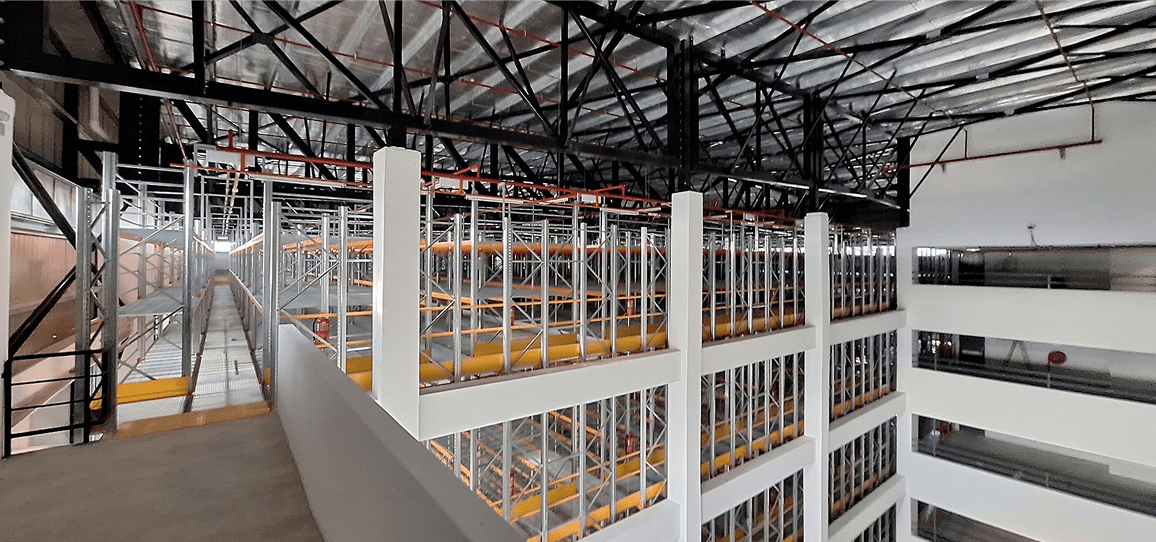
- Selective Pallet Racking: The most widely used system globally, offering direct access to every pallet. Ideal for diverse SKU ranges with moderate turnover. Commonly seen in FMCG distribution centres across the Klang Valley.
- Drive-In and Drive-Through Racking: Maximises storage density by eliminating individual aisles. Best suited for homogeneous inventory with LIFO (last-in, first-out) or FIFO (first-in, first-out) requirements. Popular in cold storage facilities in Selangor and Johor.
- Narrow Aisle (VNA) Racking: Achieves higher storage density than selective racking by reducing aisle widths to as little as 1.6 metres, requiring specialised turret trucks. Appropriate for high-value distribution centres where space is at a premium.
- Mezzanine Racking: Integrates a raised platform within the racking structure to create additional floor space particularly effective in older buildings with limited footprint but adequate height.
- Cantilever Racking: Designed for long or irregularly shaped products such as pipes, timber, or rolled materials common in manufacturing facilities in Penang’s industrial estates.
An experienced warehouse planning team will model multiple racking configurations using 3D visualisation and warehouse management simulation tools to compare storage capacity, operational efficiency, and cost-per-pallet before making a final recommendation.
Step 4: Design the Layout: Aisles, Zones and Traffic Flow
Selecting the right racking type is only part of the equation. How that racking is arranged within the warehouse footprint has an equally significant impact on operational efficiency. The layout design phase is where the expertise of an industrial design architect becomes most visible.
A well-designed warehouse layout will address:
Aisle Configuration Standard selective racking typically requires aisles of 3.0 to 3.5 metres for counterbalance forklifts. Reducing this to accommodate more racking rows may seem appealing on paper, but can create bottlenecks during peak hours a common issue in under-designed distribution centres along the North Port road network in Klang.
Zone Planning Warehouses are rarely single-function spaces. Effective layout design segments the floor into distinct zones:
- Inbound receiving and staging areas
- Primary bulk storage zones
- Pick-and-pack or order fulfilment areas
- Outbound dispatch and loading bays
- Hazardous goods storage (where applicable, subject to DOSH regulations)
Traffic Flow Mapping Pedestrian and forklift paths must be clearly separated and logically sequenced to minimise cross-traffic. One-way traffic systems, painted floor markings, and strategic placement of high-turnover items near dispatch areas are all tools used by experienced designers to reduce travel time and accident risk.
Column and Door Integration Racking rows must align with the building’s structural grid while also preserving clear paths to emergency exits and fire doors a non-negotiable requirement under Malaysian fire safety regulations.
The output of this phase is a detailed floor plan that balances maximum storage capacity with safe, efficient movement through the facility.
Step 5: Safety, Compliance and Future-Proofing
The final step in designing a warehouse racking system is ensuring the design is fully compliant, structurally certified, and built to adapt over time. In Malaysia, this means engaging with relevant regulatory bodies and standards from the outset rather than treating compliance as a final-stage checklist.
Structural Certification
All racking systems should be designed and certified by a qualified structural engineer in accordance with local and international standards such as EN 15512 or AS 4084. Rack-to-floor anchoring must be appropriate for the floor slab specification, and anti-collapse mesh or safety barriers should be incorporated where required.
DOSH and BOMBA Compliance
The Department of Occupational Safety and Health (DOSH) and the Fire and Rescue Department of Malaysia (BOMBA) both have regulations that directly affect racking design from load signage requirements to sprinkler clearances and emergency egress widths.
Seismic and Load Considerations
Peninsular Malaysia sits outside the primary seismic belt, Sabah and Sarawak are in higher-risk zones. Warehouse racking in these regions may require additional bracing and anchor specifications.
Scalability
The most forward-thinking warehouse designs build in modularity from day one. Specifying compatible racking components, maintaining adequate column spacing for future mezzanine integration, and reserving floor area for automation retrofitting are all strategies that extend the usable life of the investment.
Working with an architect who understands both the spatial and regulatory dimensions of industrial facility design is essential to getting this step right.
Conclusion
A warehouse racking system is far more than a storage solution it is the structural backbone of your entire logistics operation. Designed well, it enables faster fulfilment, safer working conditions, and scalable growth. Designed poorly, it creates congestion, safety risks, and costly retrofits down the line.
The five steps outlined in this guide defining operational requirements, conducting a structural assessment, selecting the right racking system, designing an efficient layout, and embedding compliance and future-proofing into the design represent the rigorous, architecture-led approach that today’s industrial facilities demand.
For businesses in Malaysia navigating the complexity of warehouse planning, partnering with an experienced industrial design architect is the single most important decision you can make. The difference between a facility that performs for 20 years and one that requires expensive modifications within five often comes down to the quality of design thinking at the outset.
Ready to plan your warehouse the right way?
Start with our complete guide to warehouse and industrial facility planning in Malaysia to avoid costly mistakes and get your layout right from the beginning.See how we’ve helped businesses like yours succeed by exploring our completed industrial and commercial projects across Malaysia.
When you’re ready to move forward, speak directly with our team and get expert advice tailored to your warehouse design requirements.


Read More Blogs