Warehouse Planning That Works for Your Business
Underutilised floor space costs money. Overcrowded storage areas cost even more in lost productivity, damaged inventory, and operational gridlock. For businesses across Malaysia’s booming logistics, manufacturing, and retail sectors, getting warehouse capacity right is not a luxury; it is a competitive necessity.
Yet capacity planning is one of the most misunderstood aspects of warehouse development. Many operators focus almost entirely on square footage when evaluating a facility, overlooking the vertical dimension, the flow dynamics, and the long-term scalability that determine whether a space truly works for their business.
This article breaks down the key factors that influence warehouse capacity, the steps involved in planning it accurately, and the strategies that experienced architects and operations planners use to maximise every cubic metre. If you are at the early stages of a warehousing project, we recommend starting with this industrial facility planning resource for Malaysia-based businesses before diving into the detail below.
Key Factors That Influence Warehouse Capacity
Before any planning can begin in earnest, it is essential to understand what actually determines how much a warehouse can store and how efficiently it can operate. Warehouse capacity is not simply a product of floor area. Several intersecting factors shape the true usable volume of any facility.
Building Envelope and Clear Internal Height
The clear internal height (CIH) the usable vertical distance between the finished floor and the lowest obstruction such as beams, sprinkler heads, or lighting gantries is one of the most significant capacity variables. A warehouse with a 12-metre CIH can accommodate far greater pallet volume than one with 7 metres, even if both share the same footprint. In Malaysia, many older industrial units in areas like Petaling Jaya or Cheras were built with relatively low ceiling heights, limiting the racking configurations available to tenants.
Column Grid and Structural Layout
The spacing of structural columns directly affects how racking rows can be arranged. Tight column grids force awkward aisle placements and can prevent the use of high-density storage systems altogether. When engaging an industrial design architect for a new build or fit-out, specifying a column-free or wide-bay structural grid from the outset provides significantly more layout flexibility.
Floor Loading Capacity
The rated load-bearing capacity of the concrete slab determines how many racking levels are feasible and what equipment can operate within the facility. High-bay racking with full pallet loads generates substantial point loads that must be accounted for in both the slab design and the racking specification.
Goods Profile
The nature of what is being stored dimensions, weight, fragility, temperature sensitivity, and hazard classification directly governs which storage systems are appropriate and how densely goods can be configured. A cold chain operator in Shah Alam, for example, will face very different spatial constraints than a dry goods distributor in Nilai.
Handling Equipment
The type of materials handling equipment in use has a profound effect on aisle widths, and therefore on the ratio of racking space to circulation space. Counterbalance forklifts require aisles of 3.0 to 3.5 metres; very narrow aisle (VNA) turret trucks can operate in aisles as tight as 1.6 metres, dramatically increasing storage density at the cost of higher equipment investment.
How to Plan Warehouse Capacity
Warehouse planning is most effective when approached as a structured process rather than an intuitive estimate. The following steps reflect the methodology used by professional warehouse design teams to produce capacity plans that are both realistic and resilient.
Step 1: Establish Your Inventory Data Baseline
Begin by analysing current and projected SKU data: the number of product lines, their average dimensions, weight ranges, and storage requirements. This data forms the foundation of every subsequent decision. Without it, capacity plans are speculative at best.
Step 2: Calculate Your Peak Storage Requirement
Capacity should be planned around peak demand, not average throughput. For a Malaysian FMCG distributor, for instance, inventory volumes may spike significantly in the weeks leading up to Hari Raya or Chinese New Year. Planning for average conditions will leave you short precisely when operational pressure is highest.
Step 3: Determine Your Storage Density Targets
Based on your inventory profile and handling equipment, establish target storage densities for each product category. This informs the selection of racking system types and the allocation of floor zones.
Step 4: Model Multiple Layout Scenarios
Experienced warehouse designers use 2D and 3D modelling tools to evaluate different racking configurations, aisle arrangements, and zone layouts against each other. This step is where the spatial expertise of an architect experienced in industrial facility design delivers significant value translating raw capacity data into workable, code-compliant spatial solutions.
Step 5: Validate Against Operational Workflows
A capacity plan that maximises storage density but creates bottlenecks at the loading dock or congestion in the pick-and-pack area is not a good plan. Every layout model must be tested against realistic operational workflows, including inbound receiving, put-away, picking, and dispatch.
Step 6: Incorporate a Scalability Buffer
Best practice is to plan for 80–85% utilisation at peak, leaving a buffer for operational flexibility and future growth. A facility designed to run at 100% capacity has no room to absorb demand surges or accommodate new product lines.
Strategies to Maximise Capacity Without Expanding
Expanding a warehouse footprint is expensive and, in many of Malaysia’s established industrial zones, simply not an option. For businesses working within fixed building envelopes, the following strategies offer meaningful capacity gains without the cost or disruption of construction.
Go Vertical
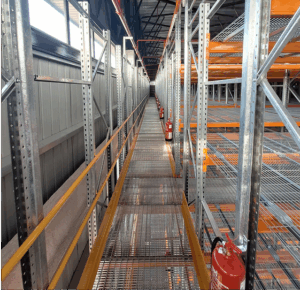
The most immediate opportunity in most warehouses is untapped vertical space. Installing or extending racking systems to make full use of available CIH combined with appropriate handling equipment can increase storage capacity by 30% to 50% in facilities that were previously limited to two or three racking levels.
Introduce High-Density Storage Systems
For inventory that does not require individual pallet access at all times, high-density systems such as drive-in racking, push-back racking, or mobile racking (live racking) can double or triple the storage positions within a given floor area by eliminating or reducing the number of permanent aisles.
- Drive-in racking suits deep, homogeneous inventory such as bulk beverages or fast-moving commodity goods
- Push-back racking allows last-in, first-out access across multiple pallet depths with better selectivity than drive-in
- Mobile racking (powered or manual) eliminates fixed aisles entirely, with a single access aisle that moves to whichever row is required particularly effective in cold storage environments where aisle space is directly correlated with energy cost
Implement Slotting Optimisation
Slotting the practice of assigning specific storage locations to products based on their velocity and handling characteristics reduces unnecessary travel within the warehouse and enables more intelligent use of premium ground-level and end-aisle positions. High-turnover items placed close to dispatch doors can cut picker travel time by 20% or more.
Leverage Mezzanine Structures
In warehouses with sufficient CIH (typically 7 metres or above), a steel mezzanine floor can effectively double the usable floor area for lighter goods, value-added services, or administrative functions all without any change to the building’s external footprint. This is a widely used strategy in older industrial units across the Klang Valley where site acquisition is not feasible.
Common Capacity Planning Mistakes to Avoid
Even with the best intentions, warehouse capacity planning projects frequently fall short due to a handful of recurring errors. Understanding these pitfalls is as important as knowing the right strategies.
Planning for Today, Not Tomorrow
Capacity plans that reflect current inventory volumes without accounting for projected business growth are effectively obsolete on the day they are completed. A well-executed warehouse design should comfortably accommodate three to five years of growth without requiring structural intervention.
Ignoring the Operational Impact of Density
High storage density and operational efficiency are not always aligned. A warehouse packed to maximum theoretical capacity may struggle with congestion, picking errors, and increased damage rates. Capacity planning must always be balanced against the throughput requirements of the operation.
Underestimating the Role of Ancillary Space
Receiving areas, staging zones, charging bays for electric forklifts, packing stations, and welfare facilities all consume floor area that cannot be used for storage. These requirements are frequently underestimated in initial capacity calculations, leading to shortfalls once the facility is operational.
Treating the Building as a Fixed Constraint
In some cases, the most cost-effective response to a capacity challenge is modifying the building itself adding a mezzanine, raising a roof section, or extending the footprint. An experienced industrial design architect will evaluate these options alongside internal reconfiguration strategies, rather than accepting the building as an immovable boundary.
Conclusion
Warehouse capacity planning is not a one-time exercise it is an ongoing strategic discipline that sits at the intersection of logistics, architecture, and business planning. Done well, it ensures that your facility can support operational excellence today while remaining adaptable to the demands of tomorrow.
For businesses across Malaysia navigating the complexities of industrial facility development, the quality of the design thinking applied at the planning stage will define the performance of the facility for years to come. Whether you are evaluating a new build in Iskandar Malaysia, retrofitting a legacy unit in Shah Alam, or planning a purpose-built distribution centre in Penang, the principles of rigorous capacity planning remain the same.
Engaging an industrial design architect who understands both the spatial and operational dimensions of warehouse design is the most reliable way to ensure your facility delivers on its full potential not just at opening, but across its entire operational life.
Take the next step with your warehouse project.
Start with the fundamentals by exploring our complete guide to warehouse and industrial facility planning in Malaysia to ensure your project is planned efficiently from day one.Discover how we bring these concepts to life through our industrial, commercial, and residential projects across Malaysia, and see the results we deliver for our clients.
When you’re ready to move forward, get in touch with our team to discuss your requirements and start planning a warehouse that is efficient, scalable, and built for long-term performance.


Read More Blogs