Warehouse vs Manufacturing Space: What You Need to Know

At first glance, a warehouse and a manufacturing facility might appear interchangeable both are large industrial buildings, both sit in industrial zones, and both involve the movement of goods. But from an architectural and operational standpoint, they are fundamentally different building types. Treating them as the same is a costly mistake that many Malaysian businesses make when planning a new industrial facility.
The distinction goes well beyond labelling. The structural requirements, spatial organisation, utility infrastructure, regulatory obligations, and long-term flexibility needs of a warehouse differ significantly from those of a manufacturing facility. Getting this wrong at the planning stage can mean a building that constrains operations from day one.
This article breaks down the key differences between warehouses and manufacturing facilities, explains how those differences should influence your building brief, and helps you make more informed decisions when commissioning industrial construction. If you are currently planning an industrial project, it is worth first understanding how purpose-built industrial projects are scoped and delivered before going further.
Defining the Two Building Types
Before comparing them, it helps to define them clearly because in practice, the lines can blur, and many Malaysian industrial facilities combine elements of both.
A warehouse is fundamentally a storage building. Its primary function is to receive, hold, and dispatch goods. The operational activity inside is largely logistical: goods arrive by lorry, are stored on racking systems or floor-stacked, and are picked, packed, and dispatched. The building serves as a controlled environment for inventory. Activity is relatively uniform across the floor plate, the processes are repetitive, and the building’s role is to maximise accessible storage volume as efficiently as possible.
A manufacturing facility or manufacturing space is a production building. Its primary function is to transform inputs into outputs through some form of process, whether that is assembly, fabrication, processing, packaging, or a combination. The activity inside is more varied, typically more equipment-intensive, and often more demanding in terms of utility services, ventilation, drainage, and structural capacity.
The practical distinction matters because it drives almost every design decision downstream: how the building is structured, how services are distributed, how the floor is specified, how the facade is designed, and how the space can be adapted as the business evolves.
Structural and Spatial Requirements
The structural and spatial logic of a warehouse is shaped by one overriding priority: maximising the ratio of usable storage volume to building footprint. This typically means:
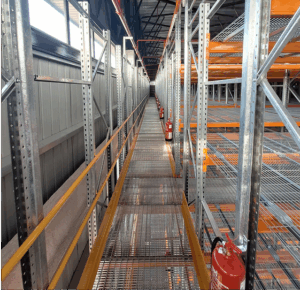
- High clear internal heights modern warehouses in Malaysia commonly specify internal clear heights of 9 to 12 metres, and sometimes higher for automated storage and retrieval systems (ASRS). This height allows racking systems to stack goods multiple levels deep, dramatically increasing storage density without expanding the footprint.
- Wide column-free spans the structural grid needs to be generous enough to allow standard racking bays to be arranged freely without structural columns creating dead zones or forcing suboptimal aisle layouts.
- Heavy-duty floor slabs warehouse floors must withstand the loads of fully loaded racking systems, forklift traffic, and concentrated point loads. Slab specifications in distribution warehouses are typically more demanding than in light industrial sheds.
- Large, level loading docks receiving and dispatch operations define the building’s perimeter logic, and the number, position, and specification of dock levellers are critical design elements.
Manufacturing spaces, by contrast, are structured around the production process rather than storage volume. This leads to a different set of priorities:
- Floor load capacity for heavy machinery a stamping press, CNC machining centre, or industrial oven imposes point loads that may require localised foundation enhancements or reinforced pits in the slab.
- Overhead crane provisions many manufacturing environments require overhead travelling cranes for lifting and positioning heavy components. The structural frame must be designed to accommodate crane beams and the dynamic loads they generate.
- Process-specific clear height requirements these vary widely depending on the manufacturing activity. A garment assembly plant needs very different clear heights from an automotive body shop.
- Dedicated utility zones compressed air distribution, three-phase power, process drainage, gas lines, and exhaust systems need to be integrated into the structural and services design from the outset.
The distinction between these two sets of requirements is one of the most important factors shaping how experienced teams approach industrial building design and specification when taking a project brief.
Services, Utilities and Environmental Needs
Perhaps the starkest difference between warehouse and manufacturing spaces lies in their utility and environmental requirements. A warehouse is relatively simple from a services perspective. The primary needs are lighting (high-bay LED systems have become the clear standard), basic ventilation, fire suppression, and power for charging forklift batteries and running administrative areas.
Manufacturing spaces are considerably more complex. Depending on the production process, a factory might require:
- High-capacity three-phase electrical supply heavy machinery, industrial ovens, dust extraction systems, and air compressors all draw significant electrical loads. The incoming supply capacity and internal distribution design must be scaled to the actual equipment load, with headroom for expansion.
- Process cooling or heating some manufacturing processes generate significant heat that must be managed through mechanical ventilation or active cooling. Others require controlled temperature and humidity environments that necessitate full HVAC systems.
- Industrial drainage and effluent management any process involving liquids washing, chemical treatment, food processing, rubber manufacturing requires carefully designed drainage systems and potentially on-site effluent treatment to meet Department of Environment (DOE) standards in Malaysia.
- Compressed air and gas distribution common in engineering, automotive, and food manufacturing, these systems need to be designed into the building fabric rather than retrofitted.
- Explosion relief or hazardous area zoning facilities handling flammable materials or generating dust must comply with DOSH (Department of Occupational Safety and Health) requirements for hazardous area classification, which affects both the building design and the specification of electrical equipment.
For businesses planning factory building design in Malaysia, this complexity is precisely why working with an experienced industrial architect and M&E engineer from the outset is so important. Getting services infrastructure wrong is one of the most expensive problems to fix once construction is complete.
Regulatory Compliance: Where the Two Paths Diverge
Both warehouses and manufacturing facilities in Malaysia must comply with local authority planning requirements, BOMBA fire safety regulations, and basic building code standards. But manufacturing spaces carry a heavier regulatory burden in several areas, and understanding this early can prevent significant programme delays.
Environmental compliance is more demanding for manufacturers. Under the Environmental Quality Act 1974 and its subsidiary regulations, factories involved in scheduled processes which include a wide range of manufacturing activities from chemical production to rubber goods must obtain scheduled waste management approvals and may need Environmental Impact Assessments (EIA). Warehouses, storing finished goods in standard conditions, are typically outside the scope of these obligations.
DOSH requirements for manufacturing environments cover machinery guarding, noise exposure, chemical handling, and ergonomic risk all of which have spatial and design implications. Factory building design must incorporate adequate clearances around machinery, defined pedestrian routes separated from material handling areas, and designated chemical storage zones with appropriate containment.
BOMBA (Fire and Rescue Department) requirements differ in important ways between the two building types. Manufacturing facilities handling combustible raw materials or generating flammable by-products are subject to more stringent fire compartmentation, sprinkler specification, and emergency egress requirements than a finished goods warehouse.
Local authority industrial classification also matters. In Malaysia, some industrial zones distinguish between “light industrial,” “medium industrial,” and “heavy industrial” categories, and not all manufacturing activities are permitted in all zones. Selecting the wrong site for a manufacturing operation can result in planning rejection or costly relocation.
Flexibility and Future Use
One of the most strategically important differences between warehouse and manufacturing space is how each ages and adapts.
Warehouses are relatively future-proof. Storage is a broadly generic function, and a well-built warehouse with adequate clear height and floor load capacity can serve a wide range of tenants and uses across its lifetime. This is one reason Malaysian warehouse assets particularly those in established logistics corridors like Port Klang, Shah Alam, and Nusajaya command strong investment interest. The building’s value is relatively independent of any single occupant.
Manufacturing spaces are more tightly coupled to the processes they were built for. A food processing plant with epoxy floor coatings, tiled wall panels, and dedicated effluent treatment infrastructure is not straightforwardly repurposed as an electronics assembly facility. This means that manufacturing facility investment decisions carry higher risk if the underlying business case changes.
The practical implication for factory design in Malaysia is that smart manufacturers build in flexibility where they can through oversized utility capacity, adaptable structural grids, and modular layout configurations so that the building can evolve alongside the business rather than constraining it.
Warehouse vs Manufacturing Space
|
Feature |
Warehouse |
Manufacturing Space |
|
Primary function |
Storage and logistics |
Production and transformation |
|
Internal height |
High (9–12m+) |
Varies by process |
|
Floor specification |
High load, even surface |
Process-specific, may include pits or trenches |
|
Utility complexity |
Low to moderate |
High |
|
Environmental compliance |
Standard |
Often elevated (DOE, DOSH) |
|
Structural provisions |
Wide clear spans |
Crane rails, machinery anchors, reinforced zones |
|
Future adaptability |
High |
Moderate to low |
|
Regulatory burden |
Standard |
Higher for scheduled processes |
Conclusion
The warehouse versus manufacturing distinction is not merely semantic it is the foundation of every good industrial building brief. Understanding which type of facility you are building (or whether you need a hybrid of both) shapes structural decisions, services design, regulatory strategy, and long-term asset value in ways that cannot easily be unwound after construction begins.
In Malaysia’s competitive industrial landscape, where development costs are rising and regulatory complexity is increasing, this clarity at the brief stage is a genuine competitive advantage. The businesses that invest in getting it right upfront through thorough operational planning and experienced design leadership consistently deliver better projects on time and on budget.
If you are working through the early stages of an industrial facility project, two resources are worth your time. Start with our comprehensive guide to how industrial factory projects are designed and built in Malaysia for a solid foundation, then explore our project portfolio to see how these principles translate into real completed facilities.
We help businesses build the right space for what they actually do not just what fits the budget.


Read More Blogs